
Play Chicken road 2 Now!
Home → Strategy
Chicken Road 2 Strategy
Approaching Chicken Road 2 sensibly
Chicken Road 2 carries a theoretical RTP of 95.50%, which establishes a 4.50% house edge over extended play sessions. This percentage represents the long-run average return rather than a guarantee for individual rounds, requiring players to manage expectations accordingly. Understanding this mathematical baseline helps users avoid unrealistic profit assumptions during gameplay.
The game features a medium volatility rating alongside a maximum win cap of x3,608,855, creating a balanced risk profile. Medium volatility suggests frequent smaller payouts interspersed with occasional larger wins, unlike high-risk alternatives. This structure supports sustainable bankroll management while still offering significant upside potential for patient participants.
Unlike the original Chicken Road which holds an RTP of 98.00%, this sequel presents a slightly higher house advantage. The developer InOut Games maintains provably fair mechanics across all difficulty levels to ensure transparent outcomes. Players should compare these figures against other titles when selecting their preferred crash game environment.
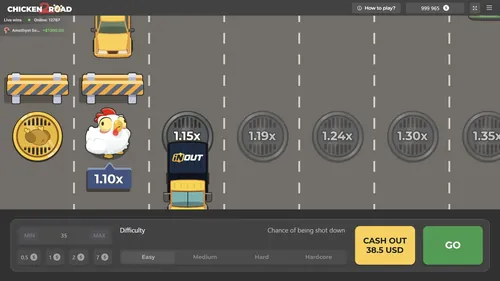
Bankroll rules that hold up
A defined bankroll serves as the dedicated money set aside specifically for playing Chicken Road 2 without affecting personal finances. Users must calculate their total session budget before placing any bets on the rising multiplier curve. Strict adherence to this limit prevents emotional decision-making during volatile market conditions.
Flat betting involves wagering the same stake every round, typically between $0.01 and $200 per ticket. This strategy minimizes variance compared to progressive staking methods that raise stakes after losses. Consistent bet sizing extends playing time and reduces the rapid depletion of funds during unlucky streaks.
Progressive staking systems increase wagers following losses but do not alter the built-in 4.50% house edge. These methods only accelerate the rate at which a player's bankroll reaches ruin during negative variance periods. Avoiding such strategies preserves capital longer and allows for more rational assessment of the game's mechanics.
Bet sizing against volatility
The minimum bet of $0.01 allows players to test the three easier difficulty levels with minimal financial exposure. Easy mode offers 30 lanes with a max multiplier of x23.24, suitable for low-risk experimentation. Starting small helps users understand the cash-out timing required before the chicken is hit in each lane.
Common systems and their limits
The maximum win of x3,608,855 in Chicken Road 2 defines the theoretical ceiling for any player session. This figure applies to the Hardcore difficulty level which features only eighteen lanes for crossing. Such a high multiplier requires extreme risk tolerance and sustained luck over many rounds. Players should recognize that hitting this cap is statistically rare despite the advertised potential.
InOut Games sets the house edge at 4.50% based on the stated RTP of 95.50%. This margin ensures the casino retains value regardless of individual crash outcomes or timing decisions. The medium volatility suggests balanced risk distribution across different difficulty tiers within the game structure. Long-term players will see returns converge toward this percentage through extensive play sessions.
Fish Road offers an RTP of 96.00% with a max win of x2,542,251.93 for comparison purposes. Chicken Road 2 provides a slightly lower return but compensates with a higher potential payout ceiling. The difference in RTP represents a small but measurable cost advantage for alternative titles. Gamblers must weigh these mathematical differences when selecting between similar instant crash mechanics.
Flat betting explained
A flat betting strategy involves wagering the same stake amount during every single round of play. For Chicken Road 2, this means consistently risking amounts between $0.01 and $200 per attempt. This approach prevents rapid bankroll depletion by avoiding aggressive escalation after losses or wins. It aligns well with the medium volatility profile of the underlying game mechanics.
The bet range allows micro-stakes starting at $0.01 for extended gameplay without significant financial pressure. High rollers can utilize the $200 upper limit while maintaining strict control over total exposure. Consistent staking removes emotional decision-making from the equation of when to cash out before the crash. Discipline remains the primary factor determining long-term survival under this structured betting method.
InOut Games supports auto mode features that facilitate consistent execution of predetermined flat betting patterns. Players can configure parameters to automatically adjust bets according to fixed rules without manual intervention. This automation reduces latency errors that might otherwise cause missed cash-out opportunities during rapid crashes. The tool enhances reliability for those adhering strictly to mathematical staking frameworks over time.
Chicken Road 2: key facts
| Parameter | Value |
|---|---|
| Game | Chicken Road 2 |
| Studio | InOut Games |
| Released | 2025 |
| RTP | 95.50% |
| House edge | 4.50% |
| Volatility | medium |
| Max win | x3,608,855 |
| Bet range | $0.01 – $200 |
Progressive staking risks
Progressive staking involves raising stakes after losses in an attempt to recover previous deficits quickly. This method does not alter the built-in house edge of 4.50% present in Chicken Road 2. Instead, it significantly accelerates the rate of bankroll erosion during inevitable losing streaks. Mathematical analysis confirms that no betting progression changes the fundamental negative expectation of the game.
The maximum win cap of x3,608,855 in Hardcore mode tempts players to increase wagers aggressively. However, chasing such extreme multipliers often leads to catastrophic failures before reaching profitable thresholds. Each additional unit risked increases the probability of total ruin rather than ensuring recovery. Statistically, this approach yields shorter sessions with lower final balances compared to conservative methods.
InOut Games released Chicken Road 2 in 2025 with provably fair technology to ensure transparency. While fairness guarantees outcome integrity, it cannot protect players from self-inflicted damage via progressive strategies. The medium volatility amplifies the psychological impact of consecutive losses when stakes are artificially inflated. Responsible gambling guidelines strongly advise against employing martingale-style systems in crash environments.
What the maths actually allows
The theoretical RTP of 95.50% indicates that players lose five cents for every dollar wagered over infinite rounds. This percentage applies uniformly across all four difficulty levels offered within the Chicken Road 2 framework. Easy mode provides up to x23.24 multipliers while Hardcore reaches the maximum x3,608,855 potential. The expected value remains constant regardless of the specific lane configuration selected by the user.
Volatility classification as medium suggests moderate variance in win frequency and payout sizes for participants. Players can expect regular smaller cash-outs interspersed with occasional larger payouts before the chicken crashes. This balance prevents extreme dry spells while still offering substantial rewards for successful timing decisions. Understanding this distribution helps manage expectations regarding short-term performance versus long-term statistical reality.
Fish Road presents a contrasting mathematical profile with its 96.00% RTP and x2,542,251.93 maximum win. Comparing these figures highlights how slight RTP differences accumulate into significant monetary gaps over time. Chicken Road 2 sacrifices one percent point of return for access to a higher absolute payout cap. Analytical players must calculate whether the extra risk justifies the potential reward differential effectively.
Reading variance honestly
Variance describes the fluctuation of results around the expected mean defined by the 95.50% RTP. In Chicken Road 2, medium volatility ensures that bankroll swings remain manageable for most participants. Short sessions may yield profits exceeding initial deposits due to random clustering of favorable outcomes. However, extended play inevitably reveals the true mathematical expectation favoring the house over time.
The release year of 2025 marks InOut Games' continued evolution of the step-based road-crossing mechanic. Modern implementations like Chicken Road 2 utilize advanced algorithms to maintain provably fair randomness. Players should interpret winning streaks as statistical noise rather than evidence of exploitable system flaws. Honest assessment requires acknowledging that luck dominates short periods while mathematics governs long durations.
Auto mode functionality allows precise control over exit strategies to mitigate unfavorable variance impacts. Users can set automatic cash-out points below the average multiplier to preserve capital steadily. This technique reduces exposure to sudden crashes that occur without warning in instant games. Strategic implementation of these tools enables more predictable results compared to reactive manual decision-making processes.
Learning the game in demo first
InOut Games provides Chicken Road 2 with a theoretical return of 95.50% over a very long run, which establishes a house edge of 4.50%. This percentage indicates that players can expect to retain ninety-five percent of their wagered funds after hundreds of thousands of rounds. The demo mode allows users to test this mathematical structure without risking real capital during the initial learning phase.
The maximum win potential reaches x3,608,855 on the Hardcore difficulty level, which features only eighteen lanes for crossing. Players must cash out before the chicken is hit to secure this multiplier, requiring precise timing rather than luck-based spins. Understanding this crash mechanic is essential before transitioning from free play to financial stakes.
Rabbit Road by InOut Games shares the identical RTP of 95.50%, confirming the studio's consistent mathematical design across titles. This comparison highlights that the specific lane count and difficulty settings are the primary variables affecting volatility. Players should note that the theoretical return remains constant regardless of the chosen difficulty tier.
Adjusting stakes to your budget
The minimum bet is set at $0.01 while the maximum allowable stake reaches $200 per round. This wide range accommodates both low-budget testers and high-rollers seeking significant exposure to the x3,608,855 max win cap. Adjusting the stake size directly influences the absolute value of any potential payout achieved before the crash.
A flat betting strategy involves wagering the same amount every round, which preserves bankroll stability during medium volatility swings. Progressive staking raises stakes after losses, but this method does not change the built-in edge and only shortens the time to ruin. Maintaining a fixed stake prevents rapid depletion of funds during inevitable losing streaks.
The welcome bonus offers 300% up to €2,000 plus 100 free spins, which significantly expands the initial bankroll. If a player deposits €2,000, they receive an additional €6,000 in bonus funds, totaling €8,000 available for play. This increased balance allows for more rounds to be played within the safe limits of the demo or real money mode.
Recognising a bad session
Medium volatility means wins occur with moderate frequency, but extended periods without a successful cash-out are common. A session lasting several hours with no positive returns indicates variance working against the player despite the 95.50% RTP. Recognizing these patterns helps prevent chasing losses with larger bets that exceed the predefined risk tolerance.
If the bankroll drops below twenty percent of its initial size, the probability of recovering the lost funds diminishes sharply. This threshold signals that the current streak of unlucky crashes has exhausted the allocated financial buffer. Stopping immediately preserves the remaining capital for future sessions where statistical regression might favor the player.
The provably fair system ensures each round is independent, meaning previous losses do not increase the chance of a near miss. Players often mistake random variance for a broken game, leading to irrational betting behavior. Accepting the 4.50% house edge as a permanent cost of entertainment is crucial for maintaining rational decision-making.
Comparing Chicken Road 2 to Rabbit Road reveals identical RTPs, so switching games does not improve the underlying mathematical expectation. Both titles operate with the same long-term return parameters defined by InOut Games. Players should focus on managing their own discipline rather than seeking alternative games to escape a negative trend.
Stopping while ahead
Cashing out before the multiplier crashes secures the profit, whereas waiting for higher multipliers risks losing the entire round stake. A successful cash-out at x2.00 doubles the initial bet, providing a clear benchmark for modest gains. Consistently targeting lower multipliers reduces volatility and extends the playing session compared to chasing the x3,608,855 jackpot.
The auto mode feature allows players to set a specific multiplier target for automatic cash-outs, removing emotional interference from the decision. Setting this target to a realistic value like x1.50 ensures steady growth of the bankroll over many rounds. This tool is particularly useful for maintaining discipline when fatigue sets in during long gaming sessions.
Withdrawal eligibility may be affected by the wagering requirements attached to the 300% welcome bonus up to €2,000. Players must complete the turnover conditions before withdrawing bonus funds, which requires playing through the specified multiple of the bonus amount. Understanding these terms prevents disappointment when attempting to access winnings generated during the promotional period.
Chicken Road 2 differs from traditional slots by lacking reels and paylines, relying instead on a single rising multiplier. This structural difference means there are no spinning symbols to distract from the core objective of timely exits. Players should adapt their strategies to this instant game format rather than applying slot-based habits.
Responsible play in practice
Setting a daily loss limit equal to ten percent of the total bankroll prevents catastrophic financial damage during unlucky streaks. For example, if the bankroll is €1,000, the daily loss limit should be capped at €100. This strict boundary ensures that even a series of failed cash-outs cannot deplete the entire allocated funds.
The KYC verification process may delay withdrawals until identity documents are submitted and approved by the casino operator. This administrative step protects the platform from fraud but requires players to plan ahead for accessing their winnings. Completing verification early ensures that funds are ready for withdrawal once wagering requirements are met.
Time management tools allow players to set session limits, preventing excessive play that leads to fatigue and poor decision-making. A two-hour limit encourages breaks, allowing for objective assessment of the current performance relative to the 95.50% RTP. Regular pauses help maintain mental clarity when evaluating whether to continue or stop playing.
Independent analysis confirms that Chicken Road 2 operates with a 4.50% house edge, which cannot be overcome by betting systems. No strategy can alter the fundamental mathematics governed by InOut Games' provably fair algorithm. Players should view the game as entertainment with a known cost rather than a viable income source.
DemoRTP & VolatilityHow to PlayAuto CashoutStrategyBonusesMobileDownload & AppMax WinSimilar GamesReviewFAQSitemap
Chicken road 2 2026