
Play Chicken road 2 Now!
Home → Mobile
Chicken Road 2 Mobile
Chicken Road 2 on mobile
InOut Games released Chicken Road 2 in 2025 as a crash game designed for immediate play without any reels or paylines. The theoretical return to player stands at 95.50%, which means the house edge is exactly 4.50% over a very long run of rounds. This mathematical structure ensures that every cash out decision directly impacts the final bankroll balance before the multiplier ends.
The maximum win potential reaches an impressive x3,608,855 multiplier, offering substantial payouts for players who time their exits correctly. By contrast, other titles like Fish Road offer a lower max win of x2,542,251.93, making this sequel potentially more lucrative for high-risk strategies. Players must understand that such high multipliers come with medium volatility, requiring careful bankroll management during each session.
Auto mode allows users to set predefined bet ranges from $0.01 to $200, automating the cash out process entirely. This feature removes manual intervention, letting the system handle entries and exits based on strict algorithmic parameters. Consequently, players can monitor multiple difficulty levels simultaneously without needing constant attention to every single rising multiplier.
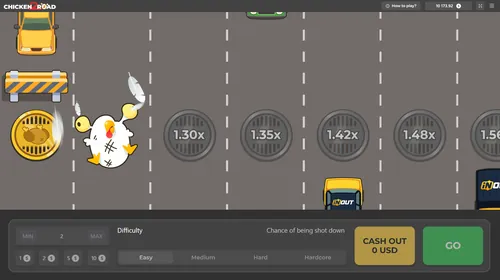
Playing in the mobile browser
Players accessing Chicken Road 2 via mobile browsers encounter a direct interface that bypasses app store restrictions entirely. The game operates on provably fair technology, ensuring that every round outcome is mathematically verifiable by the user. This transparency builds trust since no third-party software installation is required to verify the integrity of the random number generation.
Welcome bonuses often include a 300% match up to €2,000 plus 100 free spins for new registrations. However, crash games like this one typically contribute differently to wagering requirements compared to traditional slots. Users should check specific terms because some operators exclude instant games from bonus eligibility or apply reduced contribution percentages.
Browser performance depends heavily on the device's ability to render real-time graphical updates smoothly. Since Chicken Road 2 involves rapid multiplier increases, lag can cause missed cash out opportunities within critical seconds. Testing on various devices ensures that the visual feedback remains synchronized with the actual game state for accurate decision-making.
Screen layout on phones
The Easy difficulty level features 30 lanes and offers a maximum multiplier of x23.24 for conservative players. This layout provides a wide safety margin, allowing beginners to understand the mechanics without risking large portions of their balance. The visual density is low, making it easy to track the chicken's path across the screen without confusion.
Hardcore mode reduces the lane count to just 18 but scales the maximum win up to x3,608,855. This drastic change requires intense focus as the probability of collision increases significantly with fewer safe paths available. The screen layout adapts to highlight these risks, forcing players to make quicker decisions under pressure during each round.
Medium difficulty strikes a balance with 25 lanes and a max win potential of x2,457. It serves as a middle ground between the safe Easy mode and the risky Hardcore option. Players often start here to gauge their risk tolerance before committing to higher stakes or switching to the most volatile settings available in the menu.
Touch controls and buttons
The primary interaction involves tapping the cash out button before the chicken collides with an obstacle. This simple mechanic replaces complex spin controls found in slots, focusing entirely on timing and reaction speed. Missing the tap by even a fraction of a second results in an automatic loss for that specific round.
Adjusting bet sizes uses standard +/- buttons located near the main action area for quick access. Users can modify amounts from the minimum $0.01 up to the maximum $200 limit instantly. This flexibility allows players to adapt their stake size dynamically based on their current confidence level and remaining bankroll.
Auto mode toggles allow setting stop-loss limits and target win amounts to automate gameplay completely. These controls help enforce discipline by preventing emotional betting decisions during losing streaks or excessive wins. Configuring these parameters beforehand ensures that the game adheres to pre-defined financial boundaries without manual interference.
Performance on older devices
InOut Games optimized Chicken Road 2 to maintain stable frame rates on hardware released several years ago. The lightweight code ensures that the rising multiplier animation remains smooth even on processors with limited graphics capabilities. This optimization prevents stuttering that could otherwise obscure critical moments when deciding whether to cash out.
Battery consumption remains moderate due to the absence of heavy 3D rendering or continuous background processes. Unlike video slots that require constant asset loading, this crash game only renders essential elements for each active round. Players can enjoy extended sessions without rapidly draining their device power reserves during typical usage patterns.
Data usage is minimal because the game communicates primarily through small JSON packets rather than streaming media. This efficiency makes it accessible in areas with unstable internet connections where large file transfers would fail. The lightweight nature ensures that connectivity drops do not result in lost bets or corrupted game states.
Chicken Road 2: key facts
| Parameter | Value |
|---|---|
| Game | Chicken Road 2 |
| Studio | InOut Games |
| Released | 2025 |
| RTP | 95.50% |
| House edge | 4.50% |
| Volatility | medium |
| Max win | x3,608,855 |
| Bet range | $0.01 – $200 |
Data use during play
InOut Games structures Chicken Road 2 as a crash game where the player monitors a rising multiplier that ends abruptly if the chicken is hit. This mechanic demands constant internet connectivity to ensure the provably fair round updates in real time without lag or disconnection errors for the user. Players betting between $0.01 and $200 must maintain stable bandwidth because any interruption prevents cashing out before the round terminates. The maximum win potential of x3,608,855 relies entirely on this uninterrupted data flow reaching the server instantly.
The theoretical return of 95.50% applies over a very long run, meaning short sessions with unstable connections yield unpredictable results compared to the house edge of 4.50%. A dropped packet during a high multiplier phase can cost the entire wagered amount since the crash happens before the cash-out command registers. Users should compare this risk to games like Dice by Spribe, which also require stable links for its adjustable volatility features. The medium volatility of Chicken Road 2 amplifies this dependency because wins occur less frequently but require precise timing to secure payouts.
Playing on unstable connections
Chicken Road 2 operates with four difficulty levels, ranging from Easy with 30 lanes to Hardcore with only 18 lanes and a max win of x3,608,855. Unstable networks disproportionately affect the Hardcore mode because the higher risk requires faster reaction times to cash out before the crash. In contrast, the Easy level allows up to x23.24 returns, giving players more buffer time against latency spikes during the ascent. The 2025 release ensures modern protocols, but network jitter still poses a threat to securing the upper multiplier tiers effectively.
Battery drain in long sessions
Continuous monitoring of the rising multiplier in Chicken Road 2 consumes significant device power, especially when utilizing the auto mode feature for extended periods. The medium volatility means rounds last longer on average, requiring the screen to remain active and the processor to render the animation continuously. Compared to slots that spin briefly, this instant game keeps the CPU busy calculating the trajectory until the chicken hits or the player exits. Battery depletion becomes a practical concern when attempting to chase the maximum win cap of x3,608,855 over many consecutive bets.
Portrait and landscape modes
InOut Games designs Chicken Road 2 to function seamlessly in both portrait and landscape orientations, ensuring the lane structure remains visible regardless of device rotation. The 4.50% house edge applies equally across all display modes, so switching views does not alter the mathematical expectation or the RTP of 95.50%. Landscape mode offers a wider view of the 30 lanes in Easy mode, while portrait mode concentrates the action for quicker decision-making in Hardcore mode. This flexibility supports players managing their bankroll between $0.01 and $200 without compromising the clarity of the crash point.
Sound and animation settings
Players can adjust sound and animation settings in Chicken Road 2 to reduce distractions while focusing on the critical moment of cashing out before the crash. High-quality animations enhance the visual feedback of the multiplier climbing toward the max win of x3,608,855, but they may increase GPU usage on older devices. Disabling effects might help maintain frame rates during intense sessions in the Hard mode with 22 lanes, where speed is essential. The provably fair algorithm runs independently of these visual settings, ensuring the outcome at 97.00% RTP standards remains unaffected by user preferences.
Phone versus desktop play
The maximum win of x3,608,855 remains identical regardless of the device used for Chicken Road 2. This ceiling is determined by the Hardcore difficulty level with eighteen lanes, not by screen dimensions or input methods. Players on smartphones can trigger this top prize just as easily as those on a desktop monitor during any given round.
InOut Games designed the crash mechanic to function uniformly across all platforms without performance degradation. The theoretical return of 95.50% applies equally to mobile browsers and PC clients, ensuring statistical consistency. This uniformity prevents any device-specific advantage or disadvantage when calculating long-term expectations.
The betting range spans from $0.01 up to $200 per round on every supported interface. Users retain full access to auto mode settings and provably fair verification tools while playing on smaller screens. No feature restrictions apply simply because a player chooses a portable device over a stationary computer.
Tablet experience
Tablet screens offer an optimal viewing area for monitoring the rising multiplier in Chicken Road 2. The medium volatility profile allows players to observe lane dynamics clearly without excessive zooming or scrolling. This balance supports focused decision-making during the critical cash-out phase of each game round.
Comparing this title to Spaceman reveals distinct interface differences despite similar instant gameplay structures. Pragmatic Play’s high-volatility release features a different visual layout that may feel cramped on tablet displays. In contrast, the lane-based design of Chicken Road 2 utilizes horizontal space more effectively for readability.
Touch controls provide intuitive interaction for selecting difficulty levels ranging from Easy to Hardcore. Players can switch between thirty lanes in the Easy tier and eighteen in the Hardcore tier with a single tap. This tactile feedback loop enhances precision when executing rapid cash-outs before the chicken hits a wall.
What changes on a small screen
Smartphone interfaces require condensed UI elements to accommodate the four distinct difficulty modes within limited width. The house edge of 4.50% remains constant, but visual clarity of individual lanes decreases slightly on narrow displays. Users must rely on larger touch targets to select their preferred risk level accurately.
Font sizes and button placements adapt automatically to ensure the bet range from $0.01 to $200 remains accessible. Unlike traditional slots with reels, this crash game does not suffer from symbol occlusion on compact screens. The absence of spinning animations means text and numerical data stay legible at all times.
Battery consumption and data usage remain lower compared to graphically intensive titles like Fortune Rabbit. Pocket Games Soft’s three-reel grid demands more rendering power than the linear progression of Chicken Road 2. This efficiency allows extended play sessions on mobile devices without significant thermal throttling or network latency issues.
Interrupted rounds and reconnects
Network disruptions during a rising multiplier round result in automatic termination of the current sequence in Chicken Road 2. Since the game relies on real-time server validation for its provably fair algorithm, a lost connection prevents further action. The wagered amount is returned to the bonus balance if the round ends prematurely due to technical failure.
Reconnecting after a brief drop requires initiating a new round rather than resuming the previous multiplier ascent. Each spin represents a fresh independent event with a new random seed generated by InOut Games’ system. Players cannot recover partial progress from a disconnected session, maintaining strict integrity standards.
Desktop connections generally offer higher stability than mobile networks, reducing the frequency of such interruptions. However, the medium volatility ensures that frequent small wins occur often enough to offset occasional disconnections statistically. The theoretical RTP of 95.50% accounts for these operational variances over hundreds of thousands of rounds.
Mobile demo mode
The free-play version of Chicken Road 2 mirrors the real-money mechanics exactly, including the x3,608,855 max win potential. Virtual credits allow users to test all four difficulty levels without financial risk or registration requirements. This simulation provides accurate feedback on the timing required for successful cash-outs.
Demo mode does not contribute toward any welcome bonus wagering requirements offered by online casinos. The 300% match up to €2,000 only applies to deposits made into a real-money account. Players must transition to live mode to convert virtual winnings into withdrawable cash.
Provably fair verification tools remain fully functional in the trial environment for educational purposes. Users can inspect the hash chains and seeds used to generate each round’s outcome independently. This transparency helps establish trust in the game’s randomness before committing actual funds to the $0.01 minimum bet.
DemoRTP & VolatilityHow to PlayAuto CashoutStrategyBonusesMobileDownload & AppMax WinSimilar GamesReviewFAQSitemap
Chicken road 2 2026