
Play Chicken road 2 Now!
Home → How to Play
How to Play Chicken Road 2
How a round of Chicken Road 2 works
InOut Games released Chicken Road 2 in 2025 as a crash game with an RTP of 95.50%, which defines the theoretical return over hundreds of thousands of rounds rather than a single session outcome. The house edge sits at 4.50%, meaning the casino retains that percentage of all wagered money in the long run, directly impacting player bankroll longevity and expected loss rates over time.
Chicken Road 2 game parameters
| Studio | InOut Games |
| Released | 2025 |
| RTP | 95.50% |
| Max multiplier | x3,608,855 |
| Bet range | $0.01 - $200 |
The game features medium volatility, balancing the frequency of wins against their size to provide a steady risk profile for participants who prefer consistent payouts over rare jackpots. This volatility level influences the pacing of the multiplier climb, requiring players to manage their bet sizes carefully to survive the inherent variance of each rising curve.
Around €2,000 welcome bonuses often require specific wagering terms that exclude or limit instant games like this one, forcing players to check if Chicken Road 2 counts toward the required turnover. If excluded, the bonus funds remain locked until other eligible slots are played, effectively separating the promotional capital from the crash game mechanics entirely.
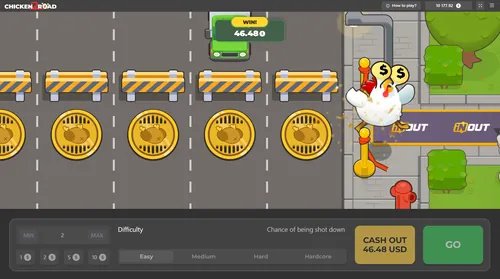
Placing your first bet
Bets in Chicken Road 2 range from $0.01 to $200 per round, allowing micro-stakers to participate alongside high rollers who wish to test the limits of the maximum win potential. This wide range ensures accessibility for different budget levels while maintaining a structured betting environment that prevents extreme fluctuations from destabilizing the game economy.
The auto mode feature lets players set predetermined cash-out points before starting a session, automating decisions that might otherwise be delayed by human reaction times during rapid multiplier climbs. This tool is essential for disciplined play, ensuring that profit targets are hit consistently without emotional interference affecting the timing of crucial exit strategies.
Provably fair technology publishes a hash for each round, enabling independent verification that the outcome was not altered after bets were placed, which builds trust in the InOut Games studio. Players can audit these hashes to confirm fairness, ensuring that the random generation of the chicken's path remains transparent and free from manipulation by the operator.
The max win cap stands at x3,608,855 on the Hardcore difficulty, representing the highest possible payout available when cashing out at the very last moment before the crash. This figure serves as an upper bound for returns, capping the potential reward regardless of how high the multiplier climbs before the inevitable end of the round.
Watching the multiplier climb
The Easy difficulty offers 30 lanes and a maximum multiplier of up to x23.24, providing a safer entry point for beginners who want to understand the mechanics without high risk. This lower ceiling reduces the pressure to act quickly, allowing players to observe the climbing pattern and practice their timing in a more forgiving environment.
Medium difficulty reduces the lanes to 25, increasing the potential upside to x2,457, which demands faster decision-making and a higher tolerance for variance compared to the easier settings. The reduced number of safe paths means the chicken has fewer options, making the climb steeper and the need for precise cash-out timing more critical.
Hard difficulty presents only 22 lanes with a max win potential of x62,162, significantly raising the stakes and requiring strict adherence to pre-set auto-cashout strategies. The scarcity of safe lanes amplifies the risk, making every second of the climb more tense and rewarding those who maintain discipline under pressure.
Hardcore mode restricts players to just 18 lanes, offering the ultimate challenge with a maximum multiplier of x3,608,855 that attracts experienced gamblers seeking massive payouts. The limited safety net forces aggressive playstyles, where waiting too long results in total loss, but timely exits yield returns that dwarf standard casino games.
Cashing out in time
Cash out refers to taking the current multiplier value before the round ends, locking in profits that would otherwise vanish if the chicken hits a wall on the next step. This action is the sole mechanism for securing winnings, as no automatic payouts occur unless the player has explicitly configured an auto-cashout threshold in advance.
The sequence involves selecting a difficulty level, placing a bet within the $0.01 to $200 range, and then monitoring the rising multiplier until the chosen exit point is reached. Timing is everything, as the difference between a small gain and a major win often comes down to milliseconds of delay in pressing the cash-out button.
Auto mode allows users to define exact multiplier thresholds, such as x2.00 or x10.00, ensuring that the system executes the cash-out automatically without manual intervention during the round. This feature eliminates reaction-time errors, providing a consistent strategy that can be backtested and optimized for long-term profitability across multiple sessions.
Comparing Chicken Road 2 to Aviator by Spribe reveals different multiplier curves, with Aviator offering a max win of x1,000,000 versus Chicken Road 2's x3,608,855 on Hardcore. These distinct ceilings influence player behavior, as higher caps encourage riskier plays in Chicken Road 2 compared to the more moderate expectations in other crash titles.
What ends the round
The round concludes when the chicken collides with a wall, instantly voiding any uncashed bets and resetting the game state for the next participant to place their wagers. This event is determined by the provably fair algorithm, ensuring that the crash point is random and unpredictable, preventing any pattern-based exploitation by smart players.
Losses occur whenever the multiplier crashes before the player initiates a cash-out, resulting in the forfeiture of the entire stake placed at the beginning of the round. This binary outcome structure means there are no partial refunds or consolation prizes, making every decision to wait for a higher multiplier a calculated risk against total loss.
Winning rounds pay out the initial bet multiplied by the value at the moment of cash-out, with the maximum possible return capped at x3,608,855 on the most difficult setting. This cap protects the casino from catastrophic losses while still offering life-changing sums to lucky players who master the timing of the hardest modes.
Unlike slots with fixed paylines, Chicken Road 2 has no spinning reels or symbol combinations, relying solely on the linear progression of the multiplier until the random crash event. This simplicity strips away complex bonus features, focusing entirely on the psychological tension of deciding exactly when to secure the growing prize pool.
Chicken Road 2: key facts
| Parameter | Value |
|---|---|
| Game | Chicken Road 2 |
| Studio | InOut Games |
| Released | 2025 |
| RTP | 95.50% |
| House edge | 4.50% |
| Volatility | medium |
| Max win | x3,608,855 |
| Bet range | $0.01 – $200 |
Difficulty levels and settings
Chicken Road 2 offers four distinct difficulty tiers, ranging from Easy with thirty lanes up to x23.24, down to Hardcore featuring only eighteen lanes for a potential x3,608,855 payout. The Easy setting provides a lower ceiling but higher safety margins compared to the aggressive risk profile of the Hardcore mode. Players must choose their lane count carefully, as fewer lanes significantly increase the multiplier growth rate per step. This structural variance allows users to tailor volatility to their specific bankroll management strategies.
The game mechanics involve crossing a road where the chicken advances until it is hit or the player cashes out. In-Out Games designed these steps to be provably fair, ensuring that each round's outcome is predetermined and verifiable via published hashes. This transparency applies equally across all four difficulty levels, preventing any hidden algorithmic bias toward the house edge of 4.50%. Users can verify past rounds independently, confirming that the multiplier rise was not manipulated after betting.
Auto mode functionality allows players to set predefined cash-out points or stop-loss limits without manual intervention during the rising multiplier phase. This feature is particularly useful for the high-risk Hardcore level, where reaction times are critical for securing the maximum win cap. The system executes trades based on strict parameters, removing emotional decision-making from the crash game equation. Such automation ensures consistent application of the chosen strategy across hundreds of consecutive rounds.
Bet limits per round
The minimum wager stands at $0.01, allowing micro-stakes players to participate in the crash mechanic without significant financial exposure. Conversely, the maximum bet limit reaches $200 per round, accommodating high rollers seeking the upper tier of potential returns. This wide range supports both casual testing of the medium volatility and serious capital deployment on the Hardcore difficulty. The disparity between entry and exit costs defines the accessible market segment for this instant game.
A single round involves one continuous rising multiplier that terminates randomly, requiring the player to cash out before the crash occurs. Unlike slots with multiple spins, here the entire stake is at risk for the duration of that single mathematical sequence. Betting $200 on the Hardcore level exposes the user to total loss if they fail to withdraw before the chicken hits. The linear nature of the bet means no partial refunds occur once the round concludes, regardless of the final multiplier value.
Comparing this to other titles, Chicken Dash by TaDa Gaming caps wins at 20,659x, while Chicken Road 2 unlocks x3,608,855 under optimal conditions. The higher max win potential justifies the broader betting spectrum, as large stakes yield exponential payouts rather than fixed line wins. Players adjusting from traditional slot formats must recognize that the $200 limit applies to the entire round, not per payline. This concentration of risk demands stricter bankroll allocation than games with dispersed losing outcomes.
Reading the interface
The main display features a central graph tracking the multiplier ascent, flanked by control panels for bet selection and auto-cashout thresholds. The current multiplier value updates in real-time, providing the critical data point required to decide when to secure profits. Interface elements remain static during the round, preventing accidental clicks from interfering with the precise timing needed for cashing out. Visual clarity ensures that the rising curve remains the focal point for strategic decision-making throughout the session.
Provably fair verification tools are integrated directly into the interface, allowing users to inspect hash seeds before or after each round concludes. This technical layer confirms that the crash point was determined before any bets were placed, aligning with the 95.50% theoretical RTP over long-term play. The interface does not obscure these cryptographic details behind complex menus, promoting transparency regarding the house edge of 4.50%. Such visibility distinguishes instant crash games from opaque proprietary algorithms found in other casino categories.
Navigation tabs separate the crash game controls from general account settings, ensuring that bet adjustments do not disrupt ongoing rounds. The layout prioritizes speed, minimizing latency between the visual cue to cash out and the system execution of the trade. Other titles like Mines or Dice by Spribe utilize similar immediate feedback loops, but Chicken Road 2 emphasizes the vertical progression of the multiplier. This design choice reinforces the core mechanic where time equals risk and reward simultaneously.
Round history and statistics
Recent round results are displayed in a horizontal scrollable list, showing the final multiplier value for each completed session. This historical data helps players identify patterns in the random number generator, although each event remains statistically independent. The list typically includes multipliers ranging from low crashes near x1.00 to occasional extreme spikes exceeding x1000 on the Hardcore level. Tracking these outcomes aids in assessing whether the actual return aligns with the stated 95.50% RTP over time.
Statistics regarding hit frequency are implicit in the volatility setting, with medium volatility suggesting a balanced distribution of small and moderate wins. Unlike Dice which offers adjustable volatility, Chicken Road 2 maintains fixed risk profiles per difficulty level, limiting statistical variability. Players cannot alter the underlying probability matrix, making historical analysis more about personal performance than game manipulation. The absence of adjustable parameters ensures that the house edge remains constant at 4.50% across all sessions.
Comparison with adjacent genres reveals that Plane Game by Spribe shares the high-volatility crash mechanic but lacks the step-based lane structure. Chicken Road 2’s history log reflects its unique lane-count mechanic, where higher difficulties produce longer winning streaks interspersed with sudden losses. Users analyzing this data should note that max win events are rare outliers rather than expected regular occurrences. Understanding this distribution prevents chasing unrealistic expectations derived from isolated high-multiplier highlights.
Provably fair verification
Each round generates a cryptographic hash that serves as proof of the predetermined crash point before any wagers are accepted. Players can input server seeds and client seeds into external verification tools to confirm that the outcome matches the initial prediction. This process eliminates suspicion of backend manipulation, ensuring that the 95.50% RTP is achieved through genuine randomness rather than rigged algorithms. The integrity of the game relies on this transparent mathematical foundation accessible to every participant.
The verification mechanism operates independently of the developer, InOut Games, allowing third-party auditors to validate the fairness of the code. Unlike traditional slots where RNG cycles are proprietary, this open approach provides granular insight into each individual game result. Users verifying a round will see that the multiplier stopped exactly at the predicted value, regardless of whether they cashed out early or late. This accountability builds trust in the platform’s commitment to regulatory standards beyond mere licensing.
Other instant games like Plinko also employ provably fair systems, but Chicken Road 2 integrates this directly into its step-based progression logic. The complexity increases with harder difficulty levels, as the smaller lane counts require precise randomization to maintain the advertised x3,608,855 max win potential. Verifying these high-value rounds is essential for players risking larger stakes, as even minor deviations would drastically impact expected returns. The system ensures that no amount of skill or timing can alter the fundamental fairness of the underlying mathematics.
Manual play versus automation
InOut Games released Chicken Road 2 in 2025 with a theoretical RTP of 95.50%, establishing a house edge of 4.50% that applies equally to manual and automated rounds. This fixed return percentage means players lose roughly five euros for every hundred wagered over an extended session, regardless of whether they click manually or use the auto mode feature. Manual control allows immediate cash out decisions when the multiplier rises, while automation executes trades without human delay. Players should note that auto mode does not alter the underlying probability of the chicken crossing safely.
The maximum win potential of x3,608,855 exists in the Hardcore difficulty level, which features only eighteen lanes compared to thirty in the Easy mode. Choosing the lowest bet of $0.01 per round minimizes financial exposure during these high-variance crashes, whereas the maximum stake of $200 accelerates bankroll depletion significantly. Automation is often preferred by experienced users who monitor multiple rounds simultaneously, but it removes the ability to react to sudden pattern shifts in the multiplier curve. The provably fair system ensures that neither manual nor automated strategies can predict the exact crash point before it occurs.
Comparing Chicken Road 2 to Spaceman by Pragmatic Play reveals distinct volatility profiles despite both being crash games. Spaceman offers a higher RTP of 96.50% and a max win of 5000x, whereas Chicken Road 2 provides up to x3,608,855 with medium volatility. This difference implies that Chicken Road 2 payouts are less frequent but potentially much larger than those in Spaceman. Players switching between these titles must adjust their betting size accordingly, as the medium volatility of Chicken Road 2 requires more patience than the high volatility of its competitor.
Common beginner errors
A frequent mistake involves misunderstanding the medium volatility rating of Chicken Road 2, leading players to expect frequent small wins similar to low-volatility slots. Since this is a crash game with no paylines, players often chase losses by increasing their bet after a failed cash out, which quickly depletes the initial deposit. The theoretical return of 95.50% guarantees long-term loss, so beginners must accept variance rather than trying to force a win through aggressive betting patterns. Recognizing that each round is independent helps prevent emotional decision-making during losing streaks.
Another error is ignoring the four difficulty levels available in InOut Games title, particularly the Hardcore mode with eighteen lanes and a max win of x3,608,855. Beginners often start with this hardest setting, assuming the high reward justifies the risk, but the lower number of safe lanes drastically reduces the chance of successful cash outs. Starting with the Easy mode, which offers thirty lanes and a lower max win of x23.24, provides a safer learning environment for understanding the game mechanics. This approach allows new players to grasp the timing required for cashing out without facing extreme volatility immediately.
Players also frequently overlook the bet range limits, placing stakes that are too high relative to their bankroll when attempting to recover previous losses. The minimum bet of $0.01 allows for extensive play, yet many novices start at $200, risking total bankruptcy within minutes if the chicken crosses early. Understanding that the house edge remains constant at 4.50% regardless of bet size is crucial for sustainable play. Using the auto mode with conservative settings can help enforce discipline, preventing impulsive manual bets that often result from frustration after a crash.
Pacing your rounds
The speed of rounds in Chicken Road 2 depends heavily on player reaction time, as each round involves watching a rising multiplier until a cash out decision is made. With a theoretical RTP of 95.50%, there is no guaranteed duration for success, meaning some rounds may end instantly while others progress further. Players should aim for an average pace that allows sufficient observation of the multiplier curve, avoiding rapid-fire betting that leads to fatigue and poor judgment. Setting a limit on the number of rounds per hour helps maintain focus and prevents impulsive decisions driven by boredom or frustration.
Using the auto mode feature provided by InOut Games can standardize the pacing of rounds, removing the variability introduced by human hesitation or excitement. By pre-setting cash out targets, players can ensure consistent timing across multiple attempts, which is useful for analyzing performance over large sample sizes. However, this automation removes the ability to adapt to real-time changes in the multiplier trajectory, potentially missing optimal exit points. Balancing manual play for critical moments with automation for routine rounds can optimize both enjoyment and strategic consistency.
Comparing the pacing to Spaceman by Pragmatic Play highlights differences in volatility impact on round duration. Spaceman’s high volatility and 5000x max win often lead to longer waiting periods for significant multipliers, whereas Chicken Road 2’s medium volatility may result in more frequent, smaller outcomes. This difference affects how players allocate their time, with Chicken Road 2 requiring quicker decision-making cycles due to its lane-based structure. Understanding these nuances helps players choose the right game for their preferred pace, ensuring they do not rush through rounds meant for careful analysis.
Managing a session bankroll
Effective bankroll management for Chicken Road 2 starts with defining a strict loss limit based on the game’s 4.50% house edge and medium volatility. A common strategy is to divide the total session budget into small units, such as fifty $0.01 bets, to withstand the inherent variance of the crash mechanic. This approach prevents rapid depletion of funds during unlucky streaks, allowing players to continue playing within their financial comfort zone. By adhering to predefined unit sizes, players avoid the temptation to increase stakes after losses, which is a primary cause of bankroll exhaustion in crash games.
The maximum win potential of x3,608,855 in the Hardcore difficulty level suggests that large payouts are possible but statistically rare, requiring careful capital allocation. Players should reserve a portion of their bankroll specifically for higher-risk modes, ensuring that standard Easy mode sessions remain unaffected by occasional large losses. This segmentation protects the overall budget from being wiped out by a single unlucky run in the most volatile setting. Maintaining separate budgets for different difficulty levels helps players manage expectations and reduces the psychological pressure associated with chasing big wins.
Comparing bankroll requirements to Fortune Rabbit by PG Soft illustrates the impact of different game structures on fund management. Fortune Rabbit’s medium volatility and 5000x max win offer a more predictable payout schedule due to its reel-based mechanics, whereas Chicken Road 2’s crash nature demands stricter discipline. The absence of spins in Chicken Road 2 means each round is a discrete event, requiring players to reset their mental state after every outcome. This distinction necessitates a more rigorous approach to tracking wins and losses, ensuring that bankroll limits are respected regardless of short-term results.
DemoRTP & VolatilityHow to PlayAuto CashoutStrategyBonusesMobileDownload & AppMax WinSimilar GamesReviewFAQSitemap
Chicken road 2 2026